UK vs. Canada Study Visa 2026: Which is Faster and Easier?
Choosing between the United Kingdom and Canada for your international education is one of the biggest decisions you will make. Both countries boast world-class education systems, vibrant student cities, and global career opportunities. However, in 2026, the deciding factor for many students isn't just the quality of the schools—it's the student visa process.
With both governments introducing significant immigration updates over the past couple of years, navigating the paperwork can feel overwhelming.
In this comprehensive Topstudy guide, we compare the UK Student Visa and the Canada Study Permit side-by-side to find out which one is faster, easier, and best suited for your budget and timeline in 2026.
1. Processing Times: Which Visa is Faster? ⏱️
When it comes to speed, there is a clear and decisive winner.
🇬🇧 The United Kingdom
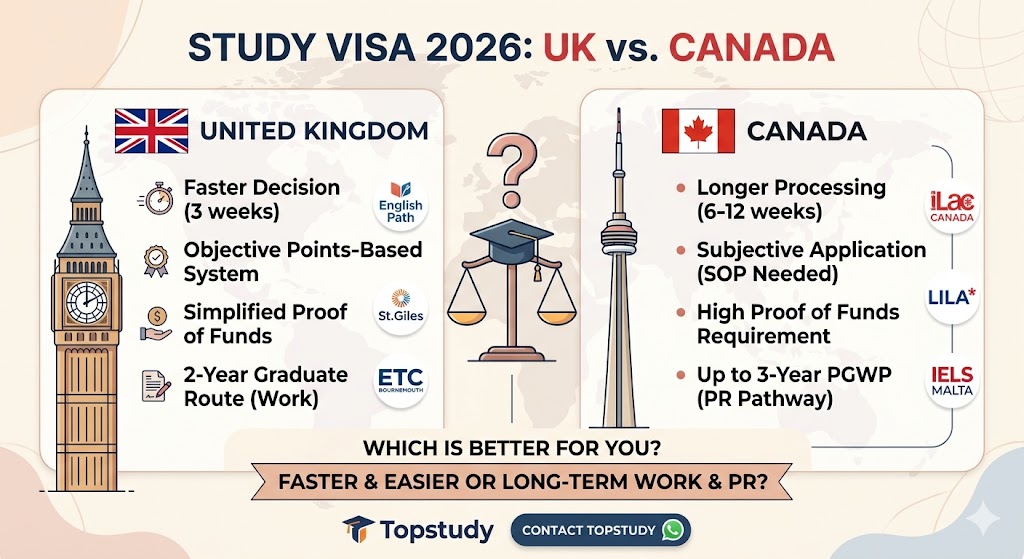
The UK student visa processing time remains remarkably streamlined. Once you submit your biometrics at a local visa application center, a standard decision typically takes just 3 weeks.
The Express Lane: If you are in a rush, the UK offers Priority (decision in 5 working days) and Super Priority (decision next working day) visa services for an extra fee.
🇨🇦 Canada
The Canada study permit processing time can be heavily unpredictable. On average, it takes anywhere from 6 to 12 weeks (and sometimes longer depending on your home country). Canada previously offered the Student Direct Stream (SDS) for rapid processing, but its recent discontinuation means all students are processed through regular queues.
The Verdict on Speed: The UK is significantly faster. If your course starts soon, the UK is your safest choice to avoid missing your intake date.
2. Financial Requirements & Proof of Funds 💰
Proving you can support yourself financially is the most common reason for visa rejections. In 2026, Canada has made this step much stricter.
🇬🇧 United Kingdom Proof of Funds
To secure a UK student visa, you must show you have enough money to pay for your first year of tuition fees, plus a set amount for living expenses for up to 9 months:
Inside London: £1,334 per month (~£12,006 total)
Outside London (Bournemouth, Liverpool, Manchester): £1,023 per month (~£9,207 total)
Note: You must hold these funds in your bank account for a consecutive 28-day period before applying.
🇨🇦 Canada Proof of Funds (The 2026 Rule)
Canada significantly increased its cost-of-living financial requirement. In 2026, international students must prove they possess a minimum of $20,635 CAD (for a single applicant) in addition to their first year of tuition and travel costs.
Note: Canadian immigration officers closely look at the source of your funds, requiring a clean, 4-month bank statement history.
The Verdict on Finances: The UK is cheaper upfront. Canada's high cost-of-living threshold means you need much more money sitting in your bank account to get approved.
3. Application Process & Difficulty: Which is Easier? 📝
🇬🇧 Why the UK is "Easier"
The UK uses a points-based system. If you get your CAS (Confirmation of Acceptance for Studies) from an accredited school like English Path or St. Giles, and you have the exact bank funds required, you are virtually guaranteed to get 100% of your points. It is a very objective, "black-and-white" process with minimal paperwork.
🇨🇦 Why Canada is "Harder"
Canada’s process is highly subjective. Even if you have the money and an acceptance letter from a premier academy like ILAC Canada, you must submit a Statement of Purpose (SOP). You have to convince the immigration officer that you intend to return home after your studies. If the officer thinks you are using the student visa purely to immigrate permanently, they can—and will—reject your visa.
The Verdict on Simplicity: The UK is easier. It has fewer subjective loops and a much lower rejection rate for prepared applicants.
4. Working While Studying & Post-Study Rights 💼
If your ultimate goal is to work abroad, the tables turn entirely.
Feature | 🇬🇧 United Kingdom | 🇨🇦 Canada |
Working During Language Courses | No. Students on short-term English visas cannot work. | No. Students taking only language courses cannot work. |
Working During University Degrees | Yes, up to 20 hours per week. | Yes, up to 20 hours per week. |
Post-Graduate Work Rights | Graduate Route: Allows you to stay and work for 2 years after completing a Bachelor's or Master's degree. | PGWP: Allows you to stay and work for up to 3 years depending on the length of your university program. |
The Verdict on Work: Canada takes the crown for long-term career immigration. While the UK offers an excellent 2-year graduate visa, Canada’s immigration pathways are explicitly designed to transition students into permanent residents (PR).
Final Verdict: Which Visa Should You Choose?
Choose the UK if: You want a fast decision, have a tighter timeline, want a simpler and more predictable application process, and are looking for lower upfront proof-of-funds.
Choose Canada if: You have a robust budget, have plenty of months to wait for processing, and your long-term goal is to permanently move, live, and work in North America.
Secure Your Visa Hassle-Free with Topstudy
Whether you choose the fast track to the UK or the long-term career path in Canada, you don’t have to handle the stress alone.
As official representatives of elite schools like English Path (UK) and ILAC (Canada), the team at Topstudy handles your entire enrollment and study visa application from start to finish—100% free of charge.
We ensure your bank statements are perfect, review your documents, and guide you through every regulation update to give you the highest possible chance of approval.
📥 Ready to start your journey? Contact our expert academic advisors via WhatsApp or submit your details on our website today, and let’s secure your student visa for 2026!