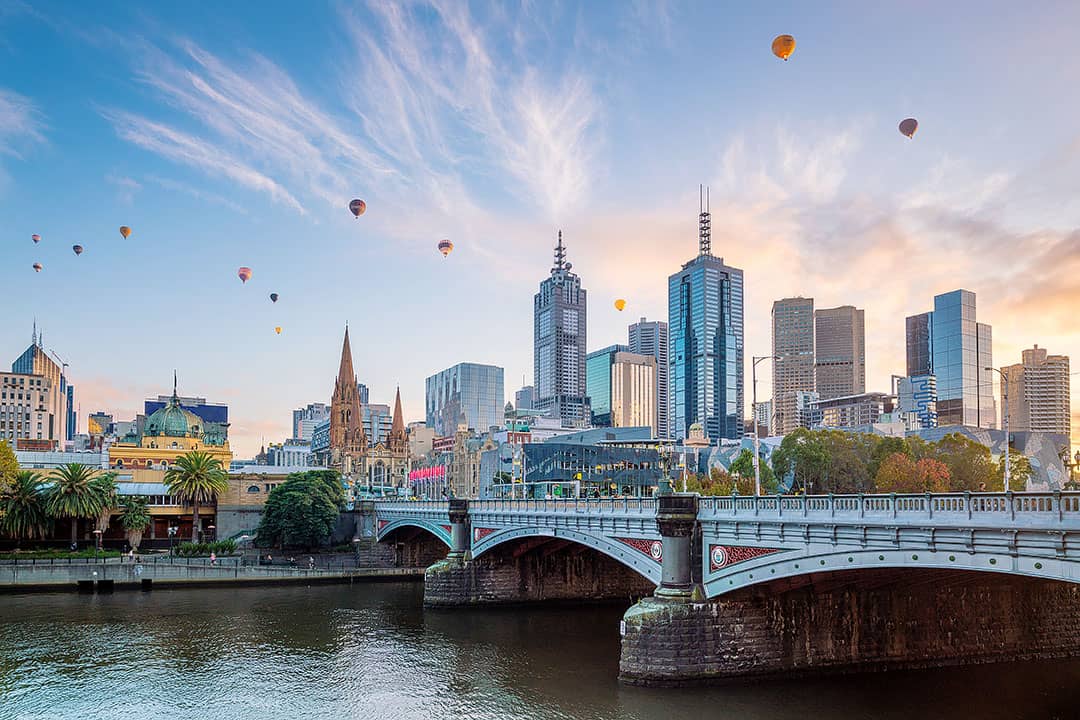

Melbourne is Australia's second-largest city and, by most accounts including those of Australians from elsewhere, its cultural capital. It sits on Port Phillip Bay in the south-east, and it is the most European-feeling of the big Australian cities — which is the single most useful thing to know when deciding between it and Sydney or Brisbane.
The city's character comes from its laneways. Melbourne's centre is a grid, but threaded through the grid is a network of narrow lanes filled with cafés, bars, street art and small shops that do not announce themselves from the main streets. Finding them is a genuine part of living here. Coffee is close to a civic institution — the city takes it seriously enough that ordinary suburban cafés serve it well — and café culture is the everyday social infrastructure in a way it is not in most English-speaking cities. For a language student that is directly useful: cafés are where unhurried conversation happens.
Melbourne is also a city of events, and they are not incidental. The Australian Open, the Melbourne Cup, the Grand Prix, the comedy and film festivals and a constant live music schedule mean there is almost always something on, much of it free or cheap. Australian Rules football is the city's genuine obsession and attending a match at the MCG is the fastest way to understand the place.
The trams are the practical backbone of the city, and the free tram zone in the central grid means moving around the centre costs nothing. Beyond the centre the network reaches the inner suburbs where most of the interesting neighbourhoods are — Fitzroy, Carlton, St Kilda by the bay.
The weather is Melbourne's running joke: "four seasons in one day" is a local saying rather than a marketing line. It is genuinely changeable, milder than Brisbane and cooler than most people expect of Australia, with real winters by Australian standards. Pack accordingly.
Costs are higher than Brisbane and broadly comparable with Sydney, which is the main argument against the city for a tight budget.
Work rights change and should be checked at source.
Studying here. Topstudy works with Oxford International Melbourne, offering General English — the standard programme building everyday fluency across reading, writing, listening and speaking. For a city like Melbourne this is usually the right fit: a standard weekly load leaves the time the city actually deserves.
Accommodation. Host families, residences and shared apartments are available. Melbourne's inner suburbs are where students generally want to be, and tram access is the thing to check rather than raw distance.
Who it is for. Students who want culture, coffee, music and events rather than beaches; anyone who would find a European-feeling city an easier landing than a purely outdoors one; and students willing to trade Brisbane's warmth and lower costs for a richer city.
Get a Quote Now